
Schleicher Projected Versus Actual Release
A projected release date is a calculation, not a promise. For an eligible TDCJ prisoner, it may mark when flat time plus good time reaches a mandatory-supervision threshold. Board approval can still be required. For a person who is not eligible for mandatory supervision, the projection may track maximum expiration unless parole occurs first.
A scheduled release date comes later, after a favorable decision and release processing. Actual release is the recorded physical exit or transfer. Discharge means completion of the sentence and release from incarceration, parole, mandatory supervision, or community supervision. These fields answer different questions.
Find a Schleicher Inmate Release Date
The correct source follows the custodian. Schleicher County Jail records and the court explain a local detainee's status. TDCJ records cover a person accepted into state prison. Federal and immigration custody require their own systems.
- Confirm the person with full name, date of birth, booking number, TDCJ number, or SID number.
- For county custody, call Schleicher County Jail at (325) 853-2737. Ask whether the person is pretrial, serving a county sentence, transferred, or released.
- Ask the County and District Clerk for the judgment, jail credit, later order, and case disposition when the court controls the date.
- For current state custody, search TDCJ by number or by name with race and sex. Read projected release, parole eligibility, maximum sentence, and current facility as separate fields.
- If the search fails, email TDCJ inmate information with the full name and TDCJ number, or exact date of birth. Telephone status is available at 936-295-6371 or 800-535-0283 during published weekday hours.
- Confirm any stated date with the custodian and the latest court or release-processing record.
The Schleicher County released-inmate lookup covers the record trail after a person has left custody.
Texas Credits and Schleicher Release Dates
Government Code §498.003 makes state good-conduct time a privilege used for parole or mandatory-supervision eligibility. It does not shorten the judicial sentence itself. Classification, work or program participation, and discipline may affect credits. Trusty and Class I categories can earn credits at rates described by statute, Class II earns less, and Class III earns none.
Parole eligibility is also offense-specific. Government Code §508.145(f) generally uses calendar time plus good time equal to one-fourth of the sentence or fifteen years, whichever is less, for many prisoners. Specified serious-offense and deadly-weapon cases under §508.145(d) generally use actual calendar time equal to one-half of the sentence or thirty years, whichever is less, with a minimum and exceptions.
Texas has no blanket 85 percent rule for all inmates. The correct calculation depends on the offense date, offense, findings, sentence structure, credits, and Board action. Eligibility allows review. It never guarantees release.
The official Texas good-conduct-time statute provides the source context shown below.
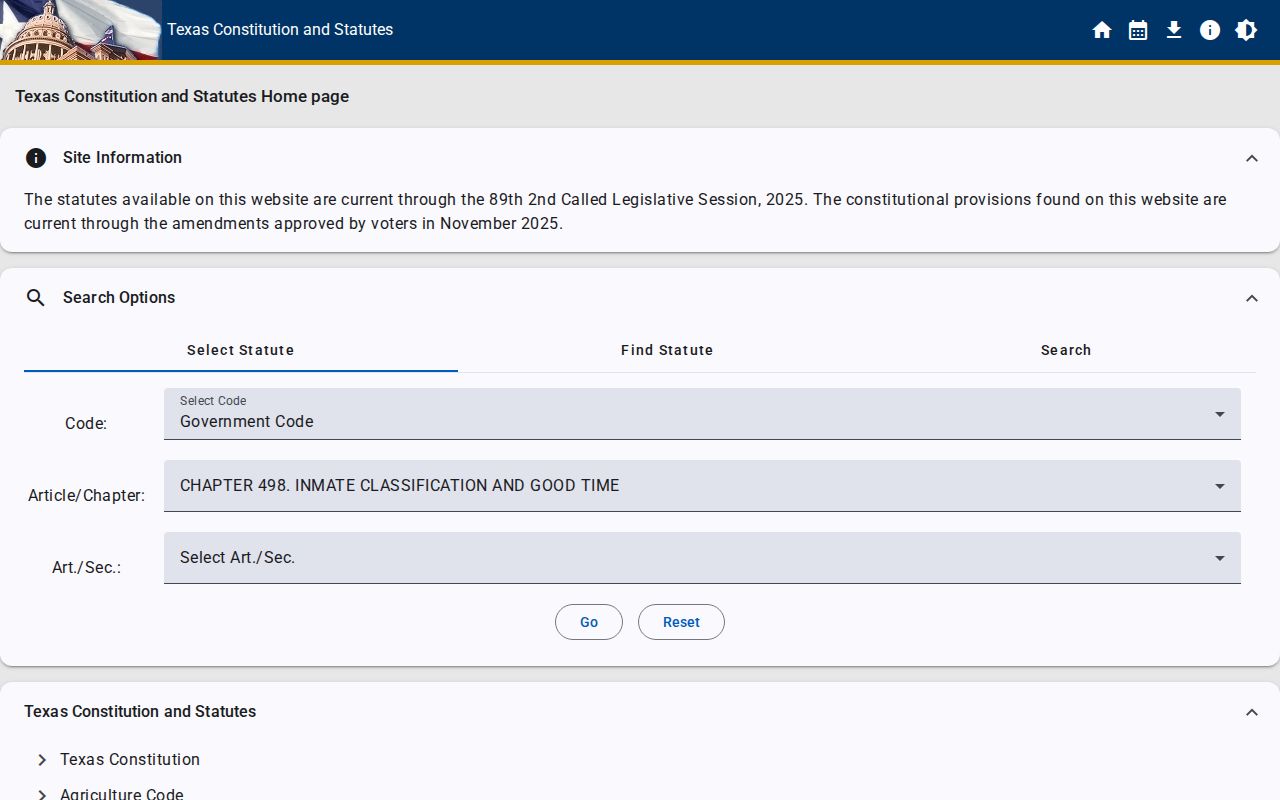
The statute explains why credits affect eligibility calculations without erasing the sentence imposed by the court.
Why Schleicher Release Dates Change
A date can move because the records used in the calculation change or because a legal decision has not finished. The safest practice is to record which field was read, the date it was checked, and the agency that supplied it.
| Factor | Possible effect |
|---|---|
| Sentence or jail-credit correction | Changes the time credited or the maximum calculation. |
| Concurrent or cumulative case | Changes how multiple sentences interact. |
| Classification or discipline | May change, forfeit, or restore good-conduct credit. |
| Parole or mandatory-supervision vote | May move a case into release processing or set a later review. |
| Detainer or hold | May send the person to another custodian rather than the community. |
| Release-plan review or audit | Can delay or revise the operational schedule. |
| New court order | May alter the authority or timing for release. |
Confirm a Schleicher Release Date
The TDCJ online search includes only people currently incarcerated in a TDCJ facility. Its data is at least a day old and updated on working days. A person who disappears may have been released, transferred, or affected by an update delay. Do not treat a blank result as proof of release.
For county custody, use Texas VINELink for a specific-person status check, then ask the Sheriff for the release type and destination. For state custody or supervision, IVSS and TDCJ channels are more apt. The VINELink release check explains the county notification route. TDCJ's public-information process can supply public portions of a release certificate, actual release or discharge date and type, sentence computation, and incarceration history, subject to confidentiality and redaction.
Schleicher County Jail Good Time
County jail credits use a different law from TDCJ credits. Code of Criminal Procedure article 42.032 permits a sheriff to grant commutation for good conduct, industry, and obedience, up to one day deducted for each day of the original sentence actually served when no misconduct charge has been sustained. Credits may be forfeited, and the sheriff keeps a conduct and calendar record.
The word “may” matters. The law does not prove that every Schleicher County jail sentence is cut in half. Ask the Sheriff how the rule was applied to the named sentence, and compare the answer with the judgment and jail-credit record. A pretrial detainee has no earned sentence-release date under this rule because guilt and a jail sentence have not yet been imposed.
Schleicher Parole Release Processing
A favorable Board vote is one stage, not the gate event. TDCJ Classification and Records must audit the file and calculate the scheduled date after the release certificate and other requirements are ready. Program completion, an approved release plan, a detainer, or a later discipline report can affect the outcome.
Before the vote, use the BPP Offender Status Line at 844-512-0461. After a favorable vote, Review and Release Processing at 512-406-5202 is the operational source. Ask for the status shown in the record, not a prediction. Official vote codes should be read by their published definitions.
Read Schleicher Release Date Fields
TDCJ date fields are related but not interchangeable. Parole eligibility marks when the law first permits review. It is not a release date. Projected release reflects a calculation based on sentence structure, eligibility, credits, and current decisions. Maximum sentence date reflects the end point shown for the sentence calculation. A scheduled date follows favorable action and operational processing. Actual release records what occurred. Discharge marks final completion of the sentence or supervision.
For mandatory-supervision-eligible offenses committed before September 1, 1996, the projected point may be when flat time and good time equal the sentence. For eligible offenses on or after that date, Board approval under discretionary mandatory supervision may be required. A denial can cause recalculation toward the maximum-expiration or discharge date. Later approval may move the date earlier.
Read the offense, offense date, sentence begin date, sentence length, and multiple-case structure with the date. A field copied without that context can mislead. If the person has more than one sentence, ask whether the terms run at the same time or one after another. The public display is a starting point; Classification and Records holds the computation.
Schleicher Court Date Checks
A person awaiting trial at Schleicher County Jail has no fixed sentence-release date. Bond may authorize release once conditions and processing are complete. A dismissal, time-served judgment, jail-credit ruling, or other court order can also control the exit. A detainer may instead cause transfer to another custodian.
The combined County and District Clerk can be reached at (325) 853-2833 or scclerk@co.schleicher.tx.us. Ask for the judgment, disposition, sentence, jail-credit entry, and later orders in the named cause. The Sheriff's book-out record then shows whether and when the jail acted. If the movement was a transfer, request the receiving agency rather than labeling the event a community release.
The county Justice of the Peace page lists jail credit among alternatives involving fines and costs. That is a court-resolution detail. It is not the same as bond, dismissal, good-conduct credit, or a TDCJ projected date. Only the individual court and jail records can show which rule applied.
Request Schleicher Release Computations
For a state record, send a focused public-information request to PIA@tdcj.texas.gov. Include the full name, TDCJ or SID number and date of birth if known, the exact documents, and a time range. Ask for public portions of the sentence computation or time sheet, release certificate, actual release or discharge date and type, and incarceration history. TDCJ may separate public status fields from confidential release-plan or victim material under Government Code §508.313.
TDCJ publishes general cost guidance. Requests under fifty pages are generally charged at ten cents per page plus delivery. Larger requests can add labor and overhead. An itemized estimate is issued when charges exceed forty dollars, and the requester must respond within the stated period. Ask for an electronic copy and a cost estimate when practical.