
Route Schleicher Custody Changes
A county book-out can point to several next steps. If the destination is the community after bond or a court order, the related case may still be active. The clerk's file can show bond terms, cause number, judgment, dismissal, sentence, or an order granting community supervision. It is a durable source, but it may not show the minute the jail completed discharge.
If the destination is TDCJ, search the state system with a TDCJ number, SID number, or enough name details to avoid a namesake. Read location, projected release date, parole eligibility date, and maximum sentence date as distinct fields. TDCJ's current locator is not a released-person archive, so use its inmate-information or records channels for an older discharge.
A federal or immigration destination calls for a different custodian. The Bureau of Prisons locator can retain historical federal release wording within its coverage. ICE's locator is designed for current detention, not a complete history. An out-of-county warrant requires checking the receiving county. Each path begins with the destination recorded by Schleicher County Jail.
Separate Person and Batch Checks
Texas VINELink answers a one-person custody question. It cannot produce every Schleicher County book-out during a day. For that batch question, a written Sheriff request should identify the exact interval and ask for the existing release or book-out entries in an available electronic form.
The two routes can support each other. A batch record identifies movements within the interval, while a VINELink event may help verify one listed person. Neither should be used alone to call a transfer a community release. Release type, authority, and destination complete the finding.
No Schleicher 24-Hour Feed
The Schleicher County Sheriff's Office page publishes no live jail roster, booking cards, release filter, or recent-release archive. It also gives no update cadence or web-retention period. Its only online custody link is VINELink. That means there is no official county webpage that can be read as a complete list of everyone released today.
For a batch of releases, ask the Sheriff's Office for existing book-out or release entries covering a stated interval. Use exact start and end timestamps and identify the time zone. A request such as midnight through 11:59 p.m. is a calendar-day request, while “the preceding 24 hours” is a moving window. Those are different sets of records.
Check Schleicher Releases Today
A reliable same-day check separates a one-person question from a request for all release entries. VINELink is designed around one named record and agency-fed events. A Public Information Act request is the sound route for a complete interval because the Sheriff does not expose a batch feed.
- Review the official Sheriff page and note the jail contact information.
- For one person, open Texas VINELink, match identifiers, and preserve the exact status wording and date.
- Call Schleicher County Jail at (325) 853-2737 to confirm the custody event, release type, and destination.
- For all book-outs, submit a narrow written request with exact start and end timestamps and ask for an existing electronic export if maintained.
- Check the court case for the bond, dismissal, sentence, jail-credit entry, or transfer authority behind the movement.
When the question concerns one named person rather than the whole day, the broader Schleicher County released inmate search explains how to follow county, state, federal, and immigration custody routes.
Schleicher Release Fields to Request
No online 24-hour table exists, so none of these fields is publicly displayed as a county feed. They are the useful data points to seek in the existing booking/release sheet, jail card, custody-status history, or comparable record. Ask for the record by name, date of birth or booking number, plus the narrow date range.
| Field | What it establishes |
|---|---|
| Name and booking number | Identifies the correct custody episode and reduces namesake errors. |
| Book-in and book-out times | Shows whether the exit falls inside the exact requested interval. |
| Release code or type | May distinguish bond, time served, court order, or transfer. |
| Release authority | Points to the court or agency action that authorized the exit. |
| Destination or receiving agency | Separates return to the community from continued custody elsewhere. |
| Charge, cause, and bond notation | Connects the jail movement to the related case and bond record. |
A booking photograph may be requested for the named booking, but it is not proof of guilt, present custody, or release. The custodian decides whether an exception or redaction applies to each responsive item.
Schleicher Release Lag and Verification
VINELink receives agency-fed custody events, so a new event may not appear at the instant jail staff complete release processing. A no-result response can also reflect spelling, identifier mismatch, a search-window limit, or a transfer to another jurisdiction. Do not convert silence into a release finding.
The county jail and TDCJ serve different populations. A person transferred from Schleicher County Jail to the Texas Department of Criminal Justice has left the local facility but remains incarcerated. TDCJ says its public inmate information is refreshed on working days and is at least 24 hours old. Its current online locator covers people currently incarcerated in a TDCJ facility, not a full archive of discharged people.
The official TDCJ email information instructions show the alternate route when a state record needs clarification.
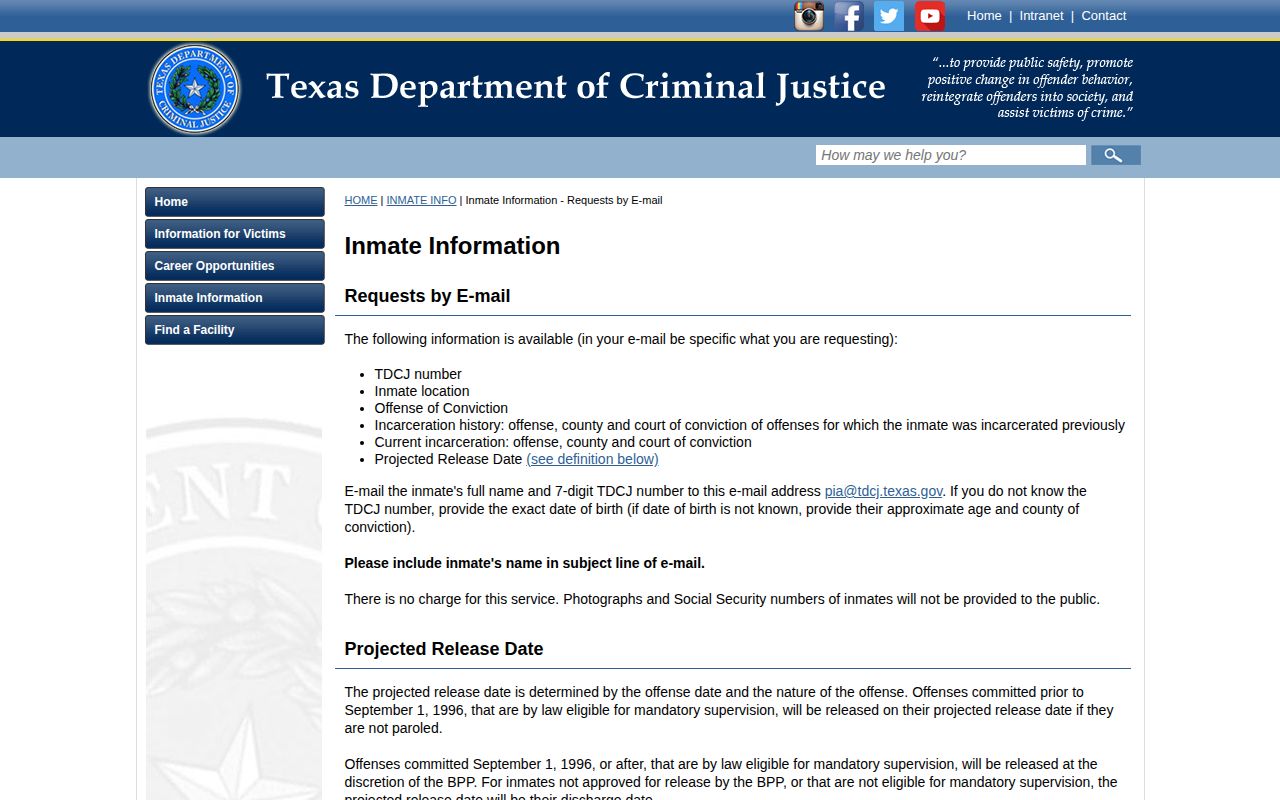
The state channel can clarify a TDCJ status, but only the Sheriff's release entry can establish a local jail book-out event and its stated destination.
Note: Record the source, retrieval time, and exact agency wording so projected dates, transfers, and completed releases do not become mixed.
Jail Credit and Schleicher Releases
The Schleicher County Justice of the Peace page identifies “Jail Credit” among options involving fines and costs. Jail credit is a court-accounting issue, not a stand-alone online release feed. It may affect how a case obligation is resolved, but the individual court record must show what the judge ordered and how that action relates to custody.
Do not equate jail credit with bond, dismissal, or acquittal. Bond ends detention subject to the pending case and conditions. Time served usually reflects a sentence or credit decision. A dismissal ends prosecution in the manner stated by the court. Each label has a distinct meaning, and the Sheriff's release type should be read beside the court disposition.
The local Justice of the Peace information supplies the county-specific court route. Exact physical release time still comes from the jail record rather than the docket alone.
Archive Schleicher Book-Out Entries
Schleicher County has no published retention window because it has no web release archive. That does not mean the underlying jail record vanished. Texas local-government schedules can assign different retention rules to jail logs, booking photos, offense records, court files, and financial material.
Ask the Sheriff which record series governs the requested item. The Texas State Library retention schedules provide the statewide framework, but the custodian must identify the responsive local series. A clear request seeks existing records and does not require the office to write a new analysis.
For a broader three-day interval, use the Released Last 72 Hours route and define the date range without calling three calendar days a rolling 72-hour feed.
Read Schleicher Release Types
A same-day entry needs context. Bond means the applicable bond was satisfied, but the charge may remain pending. Personal bond does not use a commercial surety, yet court conditions still apply. Time served reflects a sentence or credit decision, not dismissal. A sentence discharge closes the obligation described in that record, although another case, warrant, registration duty, or supervision term may remain.
Parole is release from state prison to TDCJ supervision. Probation, called community supervision in Texas, comes from a court order and may occur without a completed prison term. Transfer never means community release. A person sent to another county on a warrant or delivered to state, federal, or immigration custody stays confined under the receiving authority.
Pair the Sheriff's operational entry with the court file when the legal basis matters. A judgment may show sentence and jail credit. A dismissal order records how prosecution ended. A bond order explains why local detention ended while a case continued. The jail record remains the better source for exact exit time and receiving agency.
Public Record Search
Sponsored Results