
Schleicher County Parole Versus Probation
Parole follows a prison sentence. The Texas Board of Pardons and Paroles decides whether an eligible prisoner may serve part of a sentence in the community, while the TDCJ Parole Division supervises an approved release. Probation, called community supervision in Texas law, is imposed by a court and is administered locally. For Schleicher County, Concho Valley Community Supervision and Corrections Department handles that court-based work.
The distinction controls where to verify a status. The Board makes parole release decisions, the San Angelo District Parole Office supervises Schleicher County parolees, and Concho Valley CSCD supervises probation cases. A court clerk can confirm the judgment that created probation. None of those roles belongs to the county jail.
| Point | Parole | Probation |
|---|---|---|
| Source | Release from a TDCJ sentence after Board action | Court-ordered community supervision |
| Decision maker | Texas Board of Pardons and Paroles | Sentencing court |
| Local supervision | TDCJ San Angelo DPO, Region V | Concho Valley CSCD |
| Core record | TDCJ status, Board vote, release certificate | Judgment, docket, CSCD confirmation |
Verify Schleicher County Release Supervision
Start with the event that put the person in the community. A TDCJ prison release points toward parole, mandatory supervision, or discharge. A county court judgment may point toward probation. A bond release from Schleicher County Jail does not by itself create either status.
- Gather the full name, date of birth, and TDCJ or SID number when known. Similar names are common.
- For a state case, use the official TDCJ inmate and parole-review channels. The public inmate search is limited to people currently incarcerated, so a missing result cannot establish discharge.
- Call the BPP Offender Status Line at 844-512-0461 for the vote or review status. After a favorable vote, call Review and Release Processing at 512-406-5202.
- For parole supervision, contact San Angelo DPO and ask whether it is the assigned office. For probation, contact Concho Valley CSCD.
- Use the combined County and District Clerk record to confirm the court judgment, modification, revocation, or discharge when the legal basis matters.
Texas IVSS may provide custody, parole, mandatory-supervision, Board-decision, release, and discharge notices for a registered victim. County VINELink is a different system. It can report a jail custody event, but it does not replace a parole or probation record.
Schleicher County Supervision Contacts
The official county cross-reference assigns Schleicher County parole supervision to the TDCJ San Angelo District Parole Office, Region V. Probation has a local courthouse route through Concho Valley CSCD. Call before travel because the local probation listings do not fully agree.
Parole
TDCJ San Angelo District Parole Office, Region V
1070 Gateway Drive
San Angelo, TX 76905
(325) 947-8644
Fax: (325) 947-8599
Probation
Concho Valley CSCD Region III
Schleicher County Courthouse
2 S Divide St
Eldorado, TX 76936
(325) 853-2014
The main CSCD office is at 3036 N. Bryant Blvd., San Angelo, TX 76903, telephone (325) 659-6544. The county page also lists a Unit Supervision Officer at 608 Strong Ave., Ballinger, TX 76821, telephone (325) 365-3452. That conflicting route is addressed separately below.
Schleicher County Violations and Warrants
Conditions can require reporting, approved residence, travel limits, fees, treatment, testing, or other case-specific acts. The controlling source is the signed release certificate or court order. General descriptions should never be used to guess one person's terms.
An absconder is a supervised person alleged to have stopped reporting or left supervision. That label is not the same as a conviction for a new offense. A supervision officer can report a suspected breach, but a court or parole authority determines the next legal step. A warrant may lead to arrest, a hold, a revocation hearing, continued supervision, changed terms, or revocation. Confirm the warrant with the issuing agency and confirm custody with the jail that holds the person.
Ending Schleicher County Supervision
Supervision ends through an official act, not because an online entry vanishes. Probation may end after successful completion, a court order, revocation, or another authorized disposition. Parole or mandatory supervision can end at discharge, after revocation, or through other action recorded by TDCJ and the Board. The sentence end date and the date a person leaves prison are not always the same.
Ask for the document that proves the result. For probation, that is often the clerk's judgment, discharge order, or revocation order. For parole, seek the TDCJ status, release certificate, or discharge record. Government Code §508.313 makes substantial parts of an individual parole file confidential, including victim correspondence and release-plan material. Public status and date fields may still be separable from that protected detail. The Schleicher County released-inmate search explains how to combine a release record with court confirmation.
Schleicher County Parole File Votes
Texas does not hold a formal public hearing for each initial parole or mandatory-release review. Board members vote the file individually. TDCJ identifies a case before eligibility, an Institutional Parole Officer prepares a summary, and a three-member panel reviews the record. Two matching votes complete the decision; a third voter resolves a split.
A denial provides a next review date. Approval may include conditions, but it is not proof of physical release. Official results may show FI approval variants, NR set-offs, or serve-all outcomes. Preserve the code and check the Board's official vote definition. Do not turn a next-review date into a hearing appointment. Public Board policy meetings and revocation hearings are separate from this initial file-vote process.
The Board's parole panel review explanation shows the official process.
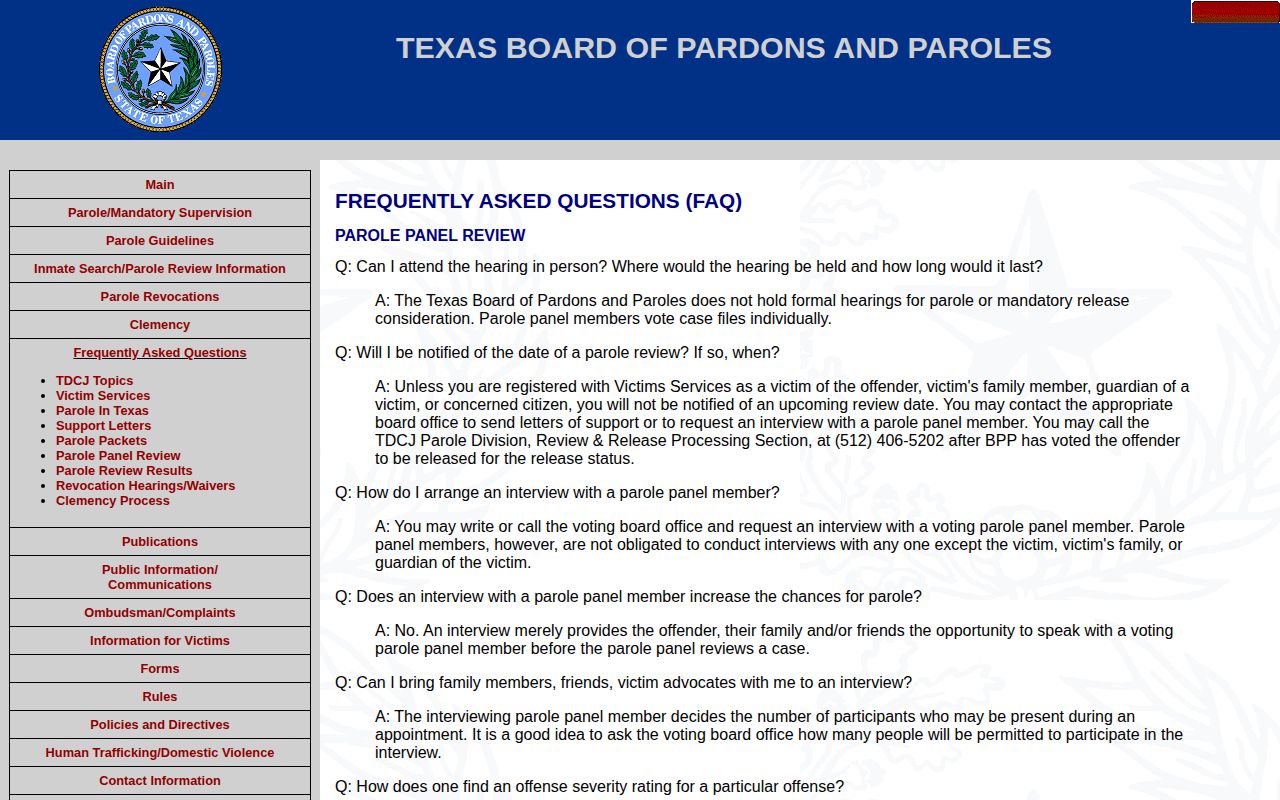
The source confirms why no Schleicher County individual hearing calendar should be expected.
Which Schleicher Supervision Office?
Schleicher County has an unusual office-directory split. The dedicated Concho Valley CSCD listing places Region III in the Eldorado courthouse. The county CSCD page identifies a unit officer in Ballinger. TDCJ separately assigns parole cases to San Angelo DPO. These are not three names for the same office.
Call first and state whether the issue is parole or probation. For probation, give the court and cause number if known and ask which CSCD location holds the file. For parole, give the TDCJ number and ask San Angelo DPO to confirm assignment. Do not send probation records to TDCJ or treat a Board vote as a county court order.
Schleicher Supervision Record Requests
When a status call is not enough, request the record from the office that made or holds it. The combined Schleicher County and District Clerk can provide court documents for probation. Its published general copy table lists one dollar per page and an added five-dollar certification charge for certified copies, but callers should confirm the rate for the exact criminal document before ordering. A plain copy may be enough for personal verification. A certified judgment or discharge order is more useful when authenticity matters.
TDCJ handles public-information requests for state correctional and parole records. A request can identify the full name, TDCJ or SID number, date of birth, document type, and time range. Public portions of the release certificate, actual release or discharge date and type, sentence computation, and incarceration history may be requested. TDCJ directs requests to PIA@tdcj.texas.gov or TDCJ Public Information Request, P.O. Box 4017, Huntsville, TX 77342. Confidential parole-file detail may be withheld.
For a simple current status, TDCJ's inmate-information email route may be faster than a broad records request. Supply the seven-digit TDCJ number with the full name. If the number is unknown, give an exact date of birth, or approximate age and county of conviction. The reply may include current location, offenses, prior incarceration history, and a projected release date. It will not supply photographs.
Schleicher Parole Revocation Process
A revocation hearing follows an alleged violation after release. It is not the initial parole file vote described above. TDCJ Hearing Operations manages revocation proceedings, and the result may include continued supervision, changed conditions, or revocation. Operational hearing schedules should not be confused with a public calendar of initial release decisions.
Probation violations return through the court process. The clerk's docket and signed order are the sound sources for what the judge decided. Until an official decision is recorded, describe the event as an allegation or pending action. A new jail booking shows custody, not the final supervision result.